
Early Pregnancy Symptoms Before Missed Period: A Complete Guide to the Two-Week Wait


What if those "phantom" cramps and sudden fatigue aren't just in your head, but are actually your body's way of signaling a major biological shift before your period even arrives? It’s completely normal to feel a mix of hope and anxiety while you analyze every twinge or mood swing during the two-week wait. You’re likely searching for clarity on whether these early pregnancy symptoms before missed period are the real deal or just another round of PMS. Since infertility affects approximately 1 in 6 couples, the pressure to know for sure can feel overwhelming.
We'll help you cut through the confusion by explaining the "symptom pivot" that happens after implantation. You'll learn how to distinguish between progesterone’s typical monthly tricks and the subtle signals of a developing pregnancy. We're also diving into the latest tech trends, like how AI and wearable devices are helping people monitor their cycles more closely than ever. By the end of this guide, you'll have a clear understanding of what's happening in your body and know exactly when to take a home test to get that 99% accurate result.
Key Takeaways
- Map out the biological timeline of the luteal phase to understand exactly when a fertilized egg begins its journey to the uterus.
- Identify specific early pregnancy symptoms before missed period, such as implantation spotting, to gain clarity during the two-week wait.
- Decode the "Progesterone Paradox" to distinguish between standard PMS and the escalating intensity of true pregnancy signals.
- Learn how to use an ovulation calculator to define the most accurate testing window and avoid the stress of a false negative.
- Discover how optimized nutrition and fertility-friendly support can ease your transition into pregnancy during the critical two-week wait.
The Biological Timeline: What Happens Before a Missed Period?
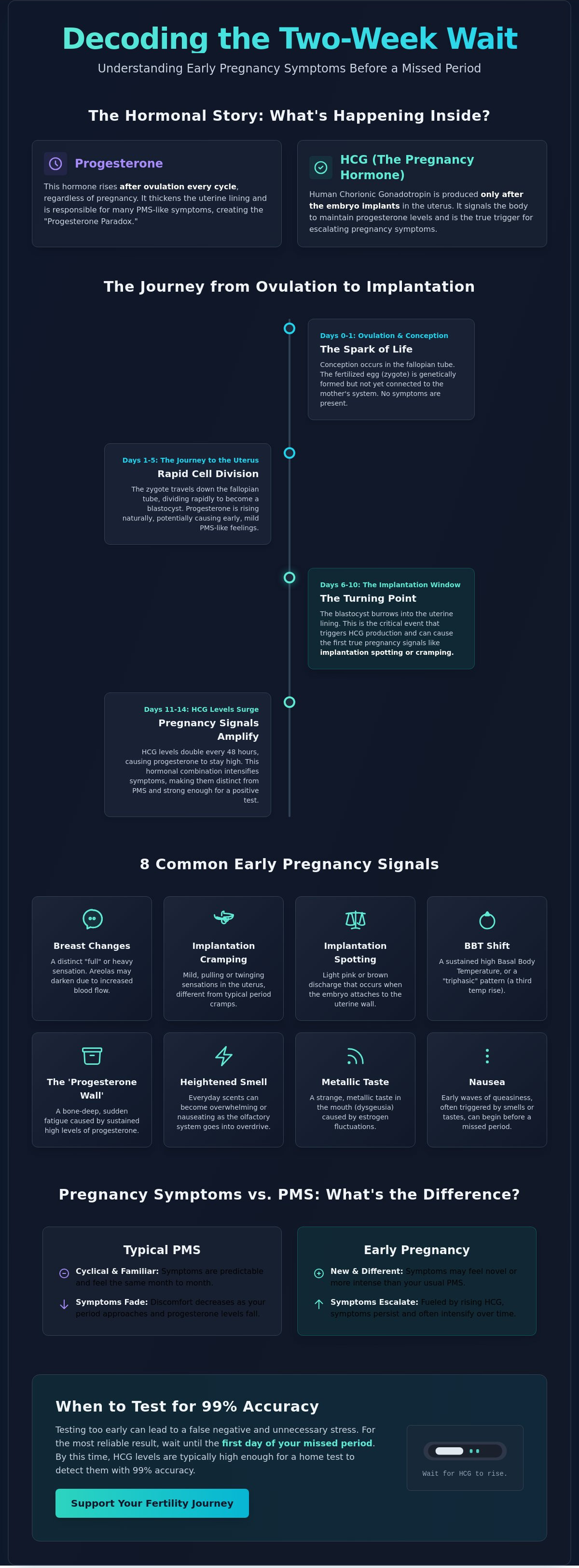
The two-week wait (TWW) isn't just a stressful countdown; it's a complex biological relay race. This period, known as the luteal phase, begins right after ovulation. Your body increases progesterone production to thicken the uterine lining, creating a welcoming environment for a potential embryo. Because progesterone rises regardless of whether you've conceived, it often mimics many early signs of pregnancy. This overlap is exactly why identifying early pregnancy symptoms before missed period feels like a guessing game.
To better understand this concept, watch this helpful video:
Until a fertilized egg successfully attaches to your uterine wall, your body doesn't produce Human Chorionic Gonadotropin (HCG). This hormone is the "pregnancy signal" that tells your system to stop the menstrual cycle and keep progesterone levels high. Without implantation, HCG remains at zero, and your symptoms remain purely hormonal rather than pregnancy-driven. Understanding your specific cycle dates is vital for this timeline, so using an ovulation calculator can help you pinpoint exactly where you are in this journey.
Conception vs. Implantation: The Critical Difference
Conception occurs in the fallopian tube within hours of ovulation. While this is the start of genetic life, it's not the start of clinical pregnancy. You won't feel "pregnant" the moment sperm meets egg because the zygote hasn't connected to your bloodstream yet. Implantation is the true turning point. It's the physical anchoring of the embryo into the uterus, which finally triggers the systemic changes that lead to early pregnancy symptoms before missed period.
The Day-by-Day Journey of the Blastocyst
- Days 1-5: The fertilized egg, now a zygote, travels down the fallopian tube. It divides rapidly, transforming into a blastocyst by the time it reaches the uterine cavity.
- Days 6-10: This is the most active window for implantation. The blastocyst "hatches" and begins to burrow into the uterine lining. This process can sometimes cause minor tissue disruption, leading to very early physical signals.
- Days 11-14: Once firmly attached, the developing placenta floods the body with HCG. Levels typically double every 48 hours, finally reaching a high enough concentration to be detected by a home test or to cause noticeable physical shifts like breast tenderness or nausea.
8 Common Early Pregnancy Symptoms Before Your Missed Period
During the two-week wait, your body becomes a focal point of intense scrutiny. While many expect dramatic changes, early pregnancy symptoms before missed period are often quiet whispers rather than loud shouts. These signals result from the sudden shift in hormones as your body pivots from a standard cycle to supporting a new life. Recognizing these shifts requires a deep dive into how your hormones actually function during this window.
- Breast Changes: High progesterone and early HCG cause blood flow to increase to the breasts. You might notice darkening areolas or a heavy, "full" sensation that feels distinct from your usual monthly soreness.
- The Progesterone Wall: This isn't just being tired; it's a bone-deep lethargy. Progesterone acts as a natural sedative. When levels stay high after implantation, you might feel like you've hit a physical wall by mid-afternoon.
- Basal Body Temperature (BBT) Shifts: If you track your BBT, a "triphasic" pattern is a strong indicator. This is a third rise in temperature occurring about 7 to 10 days after ovulation.
- Heightened Sense of Smell: Your olfactory system becomes hyper-sensitive. A scent you previously ignored might suddenly feel overwhelming or even nauseating.
Sensory and Digestive Shifts
Estrogen fluctuations can trigger a strange metallic taste in your mouth, a condition known as dysgeusia. You might also find that your favorite morning coffee suddenly smells like burnt rubber. These common early signs of pregnancy occur because your body is working to protect the developing embryo. Because progesterone relaxes smooth muscles to prevent the uterus from contracting, it also slows down your digestive tract. This often leads to early-onset bloating or constipation before you even think to reach for a test. To give your body the best start, many couples look into fertility support bundles that optimize nutrition during this sensitive time.
Physical Signs of Implantation
Implantation cramping is usually localized and much lighter than a period. It often feels like a tiny "twinge" or "pull" rather than the heavy, throbbing sensation of menstruation. Implantation spotting is a light pink or brown discharge occurring 6 to 12 days after ovulation. Not everyone sees this spotting. In fact, many successful pregnancies occur without a single drop of blood before the missed period. If you're currently in the middle of your wait, focusing on high-quality fertility products can help you feel more proactive and prepared as you monitor these subtle changes.
Pregnancy Symptoms vs. PMS: How to Tell the Difference
Distinguishing between a pending period and a potential pregnancy is one of the most frustrating aspects of the two-week wait. The challenge lies in what experts call the "Progesterone Paradox." After you ovulate, your body produces progesterone to prepare the uterine lining. This hormone is responsible for bloating, breast tenderness, and mood swings whether you've conceived or not. Because the hormonal script is nearly identical in the beginning, identifying early pregnancy symptoms before missed period requires looking for subtle shifts in intensity and duration.
When comparing Pregnancy Symptoms vs. PMS, the most reliable indicator isn't just the presence of a symptom, but its trajectory. PMS symptoms typically peak a day or two before your period starts and then vanish almost immediately once the flow begins. In contrast, pregnancy symptoms don't fade. They often escalate in intensity as HCG levels double every 48 hours. If your breast tenderness is getting worse instead of better as your expected period date approaches, it's a significant signal.
The Role of Progesterone in Both States
Progesterone is the primary driver of your luteal phase. It slows down your digestion and causes your body to retain water, leading to that familiar pre-period bloat. Because this happens every month, "symptom spotting" can easily lead to false hope. You're not imagining the physical sensations; you're just experiencing a hormone that is present in both states. The key is to watch for "pivot" symptoms that are rare in a standard cycle, such as a sudden, unexplained aversion to a food you usually love.
Key Differentiators to Watch For
- Nausea: While some people feel slightly queasy during PMS, true morning sickness (which can happen at any hour) is much more common in early pregnancy. It's often triggered by specific smells rather than general indigestion.
- Spotting: PMS spotting is usually the "prelude" to a full period, turning from pink to dark red and increasing in volume. Pregnancy spotting stays very light, often just a few drops, and doesn't progress to a flow.
- Mood Shifts: PMS mood swings often manifest as irritability or "short fuses." Pregnancy-related emotionality tends to feel more like intense, sudden bouts of weepiness or overwhelming joy that feel out of character even for your usual cycle.
If you're finding it difficult to stay objective, tracking your symptoms in a journal or app can help you see the patterns. This data becomes incredibly useful when you're trying to decide if these early pregnancy symptoms before missed period warrant an early test or if they're simply your body's standard monthly routine.
Managing the Wait: Tracking and Accuracy
The mental load of the two-week wait is often heavier than the physical symptoms themselves. It’s a period where every minor sensation is analyzed under a microscope, leading to a cycle of hope and frustration. To stay grounded, you need data rather than just intuition. If you aren't certain about your cycle dates, you might easily misinterpret normal hormonal shifts as early pregnancy symptoms before missed period. Understanding the timing of your body’s signals is the best way to reduce anxiety during this window.
Knowing your exact ovulation date is the foundation of accurate tracking. Without this, you're essentially guessing when your period is actually due. Using a reliable ovulation calculator helps you define a realistic testing window. This prevents the heartbreak of testing at 7 or 8 days post-ovulation (DPO) when it’s biologically impossible for a home test to show a result. Most embryos don't even finish the implantation process until 9 DPO at the earliest.
Testing too early often leads to "line eye," where you squint at a test trying to decide if a faint mark is an indent or a positive. Indent and evaporation lines are colorless streaks that appear as the urine dries. They aren't signs of pregnancy, but they cause significant emotional distress. Waiting until at least 12 or 14 days post-ovulation ensures that if HCG is present, it will be strong enough to produce a clear, unmistakable line on a standard test kit.
The Science of HCG and Testing Windows
Most at-home tests require an HCG concentration of at least 10 to 25 mIU/mL to trigger a positive result. This is why the "First Morning Urine" rule is so vital during the TWW. Your urine is most concentrated when you first wake up, making it easier for a test to detect those early signals that might otherwise be diluted by water intake throughout the day. HCG levels double roughly every 48 hours in early pregnancy. This rapid increase is why a test can be negative one day and clearly positive just two days later.
Practical Tips for the Two-Week Wait
- Stay Active: Light exercise like walking or yoga can help manage the fatigue caused by high progesterone levels. It also boosts your mood by releasing endorphins.
- Hydration: Drink plenty of water to help your body process hormones and reduce the bloating we discussed in previous sections.
- Journaling: Keep a simple log of your physical sensations. Over time, this helps you identify if your current early pregnancy symptoms before missed period are truly unique or just your body's standard monthly routine.
- The Stop Point: Decide on a specific date to stop testing. If you haven't seen a positive by the day your period is due, it's usually best to wait for your period to arrive rather than continuing to test multiple times a day.
If you're looking for more ways to support your body and improve your chances of a successful cycle, explore our range of fertility products designed to help you on your journey.
Supporting Your Fertility Journey with Conceive Plus
The journey through the two-week wait is often filled with a mix of excitement and apprehension. While you're monitoring for early pregnancy symptoms before missed period, your focus naturally shifts toward what you can do to support a healthy outcome. Since infertility affects approximately 1 in 6 couples, having a structured plan for nutritional and physical support can help you feel more empowered. Conceive Plus offers a range of products specifically formulated to assist couples during this critical window, ensuring that both partners are in the best possible position for a successful conception.
Using fertility-friendly lubricants and specialized supplements helps create the optimal environment for sperm to reach the egg. These tools are designed to work with your body's natural chemistry rather than against it. By prioritizing high-quality support, you're taking a proactive step in a process that often feels entirely out of your control. It's about giving your body the best resources to handle the "symptom pivot" we discussed earlier in this guide.
Preparing Your Body for Conception
Starting a prenatal regimen shouldn't wait until you see a positive test. Your body needs a foundation of essential vitamins and minerals, like folic acid and zinc, well before implantation occurs. Many couples find that using Conceive Plus bundles simplifies this process by providing comprehensive support for both men and women. These products are designed to enhance sperm motility and support regular ovulation, addressing the needs of both partners simultaneously.
Shifting your mindset from "trying" to "nurturing" is also vital. This means treating your body as if you are already pregnant during the luteal phase. Avoid harsh chemicals, stay hydrated, and use fertility-friendly lubricants that don't hinder sperm progress. It's about creating a safe, welcoming environment for that blastocyst. With the U.S. House of Representatives introducing the "Dietary Supplement Regulatory Uniformity Act" in February 2026, there is a growing push for science-based standards in the industry. This reflects the importance of choosing high-quality, trusted products that align with modern safety expectations.
Finding Community and Further Resources
You don't have to navigate this wait in isolation. Reading customer reviews from others who've shared your experience can provide much-needed validation and hope. Hearing how other women identified their own early pregnancy symptoms before missed period helps normalize the process and reduces the feeling of "symptom spotting" in a vacuum. Shared experiences are a powerful tool for reducing the anxiety that often accompanies the two-week wait.
If you're looking for more in-depth information on reproductive health, the Conceive Plus blog offers a wealth of resources on everything from cycle tracking to male fertility factors. If your test comes back positive, your next step is to schedule a confirmation appointment with your doctor. If it's negative, don't be discouraged. Each cycle is an opportunity to learn more about your body's unique patterns and to refine your approach with the right support.
Take the Next Step Toward Your Growing Family
The two-week wait is undeniably one of the most challenging parts of the conception journey. By understanding the biological timeline of implantation and the "Progesterone Paradox," you can better interpret early pregnancy symptoms before missed period without the usual anxiety. Remember that while your body's signals are real, they require time and rising HCG levels to become definitive. Staying grounded with accurate tracking and supportive nutrition ensures you're prepared for whatever result the test brings.
You don't have to leave your journey to chance. Maximize your chances of a positive test with Conceive Plus. Our formulas are developed by Harvard doctors and are clinically proven to be fertility-friendly. Trusted by millions in over 70 countries, we provide the specialized support you and your partner need to feel confident during every stage of your cycle. Your path to parenthood is unique, and having the right tools makes all the difference. Trust your body, stay patient, and know that you're doing everything possible to nurture your future.
Frequently Asked Questions
How early can pregnancy symptoms actually start?
Pregnancy symptoms typically begin after implantation, which occurs between 6 and 12 days after ovulation. Before this point, your body hasn't produced the HCG hormone required to trigger systemic changes. While some women report feeling "different" earlier, most true biological signals only emerge once the embryo connects to the uterine lining. This connection starts the rapid climb in hormone levels that eventually leads to detectable physical shifts.
Can I have pregnancy symptoms only 3 days after sex?
It's biologically impossible to experience pregnancy symptoms just 3 days after intercourse. At this stage, a fertilized egg is still traveling through the fallopian tube and hasn't yet reached the uterus or implanted. Any physical sensations you feel this early are likely related to the natural rise of progesterone that occurs during every menstrual cycle. Your body doesn't even know it's pregnant until the embryo anchors itself several days later.
Is it possible to be pregnant and have no symptoms at all before a missed period?
Yes, many women experience a completely "silent" two-week wait with no detectable early pregnancy symptoms before missed period. Every person's body reacts differently to hormonal shifts. Some individuals don't feel the effects of HCG until levels are much higher, usually around the six or seven-week mark. A lack of symptoms doesn't mean the pregnancy isn't progressing healthily; it just means your body is processing the hormonal changes more quietly.
What do early pregnancy cramps feel like compared to period cramps?
Early pregnancy cramps are usually much milder and shorter in duration than typical menstrual cramps. They often feel like light "twinges," "pinches," or "pulling" sensations in the lower abdomen rather than the heavy, throbbing ache associated with a period. These sensations are often caused by the embryo burrowing into the lining during implantation or the uterus beginning its very first stage of expansion. They shouldn't be painful enough to require medication.
Why do I feel pregnant but get a negative pregnancy test?
You likely feel pregnant because of high progesterone levels, which mimic pregnancy regardless of whether you've actually conceived. If you're truly pregnant, a negative test usually means your HCG levels haven't reached the detection threshold yet. Since home pregnancy tests are 97% to 99% accurate only after a missed period, testing too early often results in a false negative. It's best to wait 48 hours and test again with more concentrated urine.
Can stress cause early pregnancy-like symptoms?
High levels of stress can absolutely mimic early pregnancy symptoms before missed period by disrupting your natural hormonal balance. Stress can cause nausea, breast tenderness, and even delay your period, leading to a frustrating cycle of false hope. The physical toll of anxiety often mirrors the fatigue and digestive shifts associated with early pregnancy. This overlap makes it difficult to distinguish between emotional stress and true biological changes without a confirmed test result.
Does implantation bleeding happen to every woman?
No, implantation bleeding only occurs in about 25% to 30% of successful pregnancies. Many women never experience any spotting at all during their two-week wait. If it does happen, it's typically a very light pink or brown discharge that doesn't progress to a heavy flow. If you don't see any spotting, it has no bearing on your success. A lack of bleeding is just as common as its presence in healthy pregnancies.
When is the absolute earliest I should take a pregnancy test?
The absolute earliest you should take a test is 10 to 12 days after ovulation, though waiting for a missed period is more reliable. Testing before 10 DPO frequently leads to false negatives because the embryo may not have finished implanting. For the most accurate results, use concentrated first morning urine. This ensures the highest possible HCG levels for the test to detect, reducing the chance of missing a very early positive result.


